Rahvusvahelise kütusegigandi Shell esindajad kohtuvad jaanuaris Tallinna Sadama juhtidega, et teha tutvust Muugale kavandatava veeldatud maagaasi ehk LNG terminaliga. ASi Tallinna Sadam juhatuse esimees Ain Kaljurand kinnitas, et kavandatav kohtumine leiab aset jaanuari keskpaigas. Tema sõnul on kavandatava terminali puhul vaja endale leida strateegiline partner ning Shelli näol oleks tegu potentsiaalse kandidaadiga. Samas pole veel lõpuni selge, kuhu kavandatav LNG terminal ikkagi kerkib, kuna seda soovivad endale ka näiteks Läti ja Leedu. http://www.e24.ee/?id=361528
Päris palju investeeringuid Eesti energeetikasektorisse.
* LNG terminal (?);
* uus põlevkiviõlil töötav elektrijaam;
* nafta rafineerimistehas (sisuliselt done deal?);
* hiljuti valmis (vist juba?) Narva uus õlitehas;
* äkki 5 aasta perspektiivis alustatakse ka tuumajaama rajamisega;
* Estlink 2;
* Soome ning Eesti gaasivõrkude ühendamine (Eesti Gaasi initsiatiivil vist, kuigi mul on sellest esmapilgul keeruline aru saada);
* mingid Liivi lahe tuulepargid ka vist kavas, kuigi võib olla prioriteetide seas allapoole lükatud;
(+ energiakandjate transiidiga seotud investeeringud)
Nüüd ei saagi aru, kas LNG projekti planeeritakse Paldiskisse või Muugale. Viking Line'i laevatellimuse toetus läks vist riigi poolt käiku, seega neil on nüüd viimane aeg hakata endale LNG supply'd kindlustama. Samuti on Eesti LNG terminalil ilmselt võtmetähtsusega see, kuidas on võimalik Eesti Gaasi võrku vabalt gaasi müüma hakata. Neid juriidilisi piike tuleb siin veel murda.
Tahaks loota, et Läti-Leedu päris saboteerima (pole vist õnneks sellist praktikat olnud ka) ei hakka ning kui Eestil tõesti asi kõige reaalsem, siis tullakse kaasa, mitte ei jääda mängust välja. Üldiselt on nende Balti teemadega nii, et eestlastel läheb küll asjade ajamise ja tegemisega rohkem aega, kuid Läti-Leedu suunal on sahmimist-elevust rohkem, mis lõppkokkuvõttes võib Eestis märksa paremini välja tuua. Ega siis muud kui lihtsalt kindlat meelt ning sommid punti (nemad äkki siin üks olulisemaid kaaluvihte).
Lithuania seeks consultant on construction at Klaipeda LNG terminal
...
Sekmokas added that Lithuania had been pushed to build the terminal in part by Gazprom's refusal to lower gas prices. "We will see what happens with prices, but this is a real step to get gas from someone besides Gazprom", he said, informs LETA/ELTA.
http://www.baltic-course.com/eng/energy/?doc=35635

Ma kohe loodan, et terminal tuleb Eestisse kuigi lätlased ja leedulased loodavad seda endale saada. Eesti asukoht on palju mõttekam. Kui terminal Eestisse tuleb, siis Eesti suudaks jälle natuke reaalsust ära nihestada ja kasutada ära neid asjaolusid mis meil on: hea koht transiidiks, Ida ja Lääne ühendaja, Skandinaavia lähedus jne. Lisaks tundub mulle, et suurte projektide juhtimine võiks pigem olla eestlaste kui muude baltlaste käes. Kui muu ida-euroopa oli kogu N-Liidu okupatsiooni karbis kinni, neil oli ka karbi kaas suletud, siis Eestlased olid küll karbis, kuid meil olid lihtsalt seinad liiga kõrged. Meil oli vähemalt karbi kaas avatud. Me nägime päikest ja Soome TV-d. Ja seetõttu eestlased hüppasidki koheselt vabanedes lääne poole, sest nad olid juba pool elu Soome TV poolt "määritud" ja said aru mis on õige ja hea. Muud baltlased ja ka CEE nii kiirelt lääne poole ei liikunud. Minumeelest sobib see samuti Eesti profiili väga hästi, et Balti pangad (Hansapank/Swedbank ja Ühispank/SEB) on sisuliselt ju Eesti pangad. Miks Läti ja Leedu pangad ei laienenud üle-Baltilisteks üksusteks? See toob välja väga olulise ja põhimõttelise erinevuse.
«LNG terminali kõige suurem äririsk on, et Gazprom mängib gaasi hinna odavamaks, laseb lävele, millest LNG gaasi pole enam odavamalt võimalik müüa,» märkis Männi.
See ta on, matad 350 meur rajatistesse ja siis venkud näitavad keskmist sõrme kui tahavad. Natuke on riski....
See ta on, matad 350 meur rajatistesse ja siis venkud näitavad keskmist sõrme kui tahavad. Natuke on riski....
2012 on oodata tootmine Iisraeli hiiglasliku Tamar gaasiväljalt (koos poliitiliste probleemidega).
http://en.wikipedia.org/wiki/Tamar_gas_field
The report’s authors said that the gas pressure at the Tamar well is one of the highest in the world. They believe that this fact will require construction of an offshore raft to reduce the gas pressure before its arrival onshore,
http://www.offshoreenergytoday.com/israel-costs-of-gas-production-in-tamar-field-1b-higher-then-estimated/

http://www.energy-pedia.com/article.aspx?articleid=141338
http://en.wikipedia.org/wiki/Tamar_gas_field
The report’s authors said that the gas pressure at the Tamar well is one of the highest in the world. They believe that this fact will require construction of an offshore raft to reduce the gas pressure before its arrival onshore,
http://www.offshoreenergytoday.com/israel-costs-of-gas-production-in-tamar-field-1b-higher-then-estimated/
http://www.energy-pedia.com/article.aspx?articleid=141338
opex,
see on ka konkreetseks põhjuseks, miks mina olen alati seda meelt olnud, et LNG-terminali osas peaks riik ka ise mingil moel projektis osalema ja erakapitali riske veidi maha võtma. On see siis läbi Eleringi või mõne muu institutsiooni.
Kui Gazprom tahab hinnasõjaga seda projekti vee alla lasta, siis erakapitalil on tollega raske võidelda. Riigi jaoks on aga eesmärk täidetud, kuna tarbijatele on gaasi hind madalamaks saadud ning majandus konkurentsivõimelisem (+ näiteks soojaarved peaksid kukkuma).
Samuti olenemata, mida Gazprom teeb, gaasitarnijate mitmekesistamise järele januneb meie regioon igal juhul ning see tekitab LNG-teemas ikkagi siia tühja koha, mis ootab täitmist.
Race for LNG terminal in the Baltic Sea region
"...Estonia and Finland are planning to join forces on this project"...
http://www.lnggot.com/2010/race-for-lng-terminal-in-the-baltic-sea-region/
Gasum wants to build LNG terminal in Naantali
"The goal is to LNG teminalen will be completed in summer 2013 when the Viking Line’s new building is put into service on the route Turku-Stockholm"
http://www.lnggot.com/2010/gasum-wants-to-build-lng-terminal-in-naantali/
Shale gas affecting industry's pricing
...
The trend of natural gas prices has been credited to the growth in the extraction of natural gas from shale formations, including the Marcellus Shale.
Now, the U.S. Department of Energy says that the available supply of such gas is more than twice as large as it thought just a year ago. In a December update to its annual energy outlook, the agency said that the nation's supply of shale gas is 827 trillion cubic feet, 480 million cubic feet larger than last year's estimate.
http://redir.opoint.com/?url=http://www.post-gazette.com/pg/11014/1117882-28.stm&OpointData=657435536eabd5e1bd58c53a0e6945eeJmlkX3NpdGU9MjU4MDImaWRfYXJ0aWNsZT0yMzAxNyZpZF91c2VyPTc1ODYmaWRfYXBwbGljYXRpb249MTAwMDA3OCZpZF9wYXJ0bmVyPTImbGFuZz1zdiZtb249MSZtYXRjaGVzPSJMTkciNA==
Shell'i proovide tulemused kas maagaasi tootmine Lõuna-Rootsis tasub ära, oodatakse kevadel:
http://www.ystadsallehanda.se/sjobo/article1339470/Besked-om-gas-droumljer-till-varingren.html
http://www.ystadsallehanda.se/sjobo/article1339470/Besked-om-gas-droumljer-till-varingren.html
USGS: Alaska's untapped oil reserves estimate lowered by about 90 percentSubmitted by Mikael Höök on Wed, 2010-10-27 19:23. Headline news
The U.S. Geological Survey says a revised estimate for the amount of conventional, undiscovered oil in the National Petroleum Reserve in Alaska is a fraction of a previous estimate. The group estimates about 896 million barrels of such oil are in the reserve, about 90 percent less than a 2002 estimate of 10.6 billion barrels.
The new estimate is mainly due to the incorporation of new data from recent exploration drilling revealing gas occurrence rather than oil in much of the area, the geological survey said.
http://www.peakoil.net/headline-news/usgs-alaskas-untapped-oil-reserves-estimate-lowered-by-about-90-percent
Kui detsembris oli veel juttu, et India tahab Katarist sisseostetava gaasi kogust tõsta 7.5 miljoni tonni pealt aastas 12 miljoni tonni peale, siis täna on India suursaadik Kataris teinud juba juttu imporditava gaasikoguse tõstmisest 15 miljoni tonni peale aastas.
http://www.nasdaqomxbaltic.com/market/?pg=news&news_id=247332&lang=et
6 ettevõttelt oodatakse pakkumisi Klaipedos Nafta jaoks/osalusel LNG-terminali ehitamiseks.
6 ettevõttelt oodatakse pakkumisi Klaipedos Nafta jaoks/osalusel LNG-terminali ehitamiseks.
Latvia: EC may provide 30% financing for LNG terminal construction
12.04.2011 esmerk uutispalvelu
Baltic News Service, 12 Apr 2011, online
The European Commission (EC) may provide up to 30% of needed financing for LNG terminal, projected for the Baltic region, reports the Latvian Minister of Economics, Mr. Artis Kampars. The remaining amount of finances should be received from private investors. The terminal most probably will be built in Latvia, due to well developed gas storage infrastructure and geological formations, suitable for storing gas. Mr. Kampars doubts that the Latvian budget resources would be allocated for the project.
Pig’s Back to follow Barcelona template
A liquefied natural gas (LNG) terminal in the port of Klaipeda will most likely be built at Pig’s Back, a spot which is further away from residential neighborhoods in the city, reports news portal Jura. Pig’s Back has the quickest and most logical access to the Lithuanian gas trunk network.
...
Klaipedos Nafta has been commissioned to implement the LNG project. On Jan. 19 of this year, Rolandas Zukas was appointed director of the LNG terminal of Klaipedos Nafta company. Before being appointed to this position, Zukas ran Energijos Tiekimas, the subsidiary company of Lietuvos Energija. His duty now is to implement the preparation and construction of the LNG terminal project.
...
The delegation met with Prime Minister Valdis Dombrovskis (Unity) and discussed several energy and infrastructure development projects, including the construction of a liquefied gas terminal and the high-speed railroad Rail Baltica. The sides agreed that the Baltic States must achieve progress in these projects and the Baltic Assembly, in cooperation with the Baltic Council of Ministers, must agree on the location of the liquefied gas terminal. Reirs emphasized that the construction of it would facilitate Latvia’s energy independence.
Saeima Deputy Imants Paradnieks (All for Latvia-For Fatherland and Freedom/LNNK) pointed out that the location of a liquefied gas terminal must be “economically and geographically justified and Latvia is in a highly favorable position.”
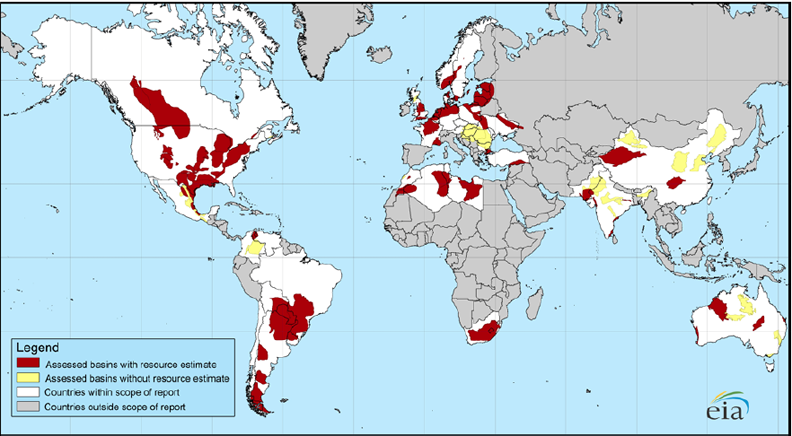
Gas Shale resources evaluated by the EIA
www.theoildrum.com
BALTIC BASIN
Geologic Characterization
The Baltic Basin (Baltic Syneclise) is a large marginal synclinal basin located in the
southwestern part of the East European Craton and a major structure of the three Baltic States.
The basin is about 700 km long and 500 km wide. The basin deepens along its NE to SW axis;
depth below sea level of the Pre-Cambrian basement increases from a few hundred meters in
Estonia to 1,900 m in southwestern Latvia, 2,300 m in western Lithuania, and 5,000 m in
Poland. This chapter will focus on the non-Polish section of the basin. (The Polish Baltic Basin
is discussed in Chapter V.)
The shale gas target in the Baltic Basin is the lower Silurian marine shale package,
which, though less mature than in Poland, has favorable characteristics for shale gas
development. ARI defined a 3,070 mi2
Res ervoir Properties (Pros pective Area)
prospective area for the Baltic Basin outside of Poland
using the 1% Ro contour line, Figure VI-2.
Depths to the base of the Lower Silurian Shale range from 5,900 feet to 7,550 feet over
the prospective area, averaging 6,720 feet, Figure VI-3. While the gross interval of the total
Silurian formation can reach 3,600 ft, the organically rich, Lower Silurian strata has a gross
thickness of 459 and, a net thickness of 284 ft, Figure VI-4.1 Total organic content (TOC) in the
prospective area ranges from 2% to 6% with an average of 4%. The thermal maturity data
ranges from 1.0% to 1.9% Ro, averaging 1.2%2
Res ources
.
Our analysis suggests the Lower Silurian Shale of the Baltic Basin contain a moderate
resource concentration of 101 Bcf/mi2. Given a 3,071 mi2 prospective area, the risked shale gas
in-place is 93 Tcf. Based on favorable reservoir properties and mineralogy, we estimate a
risked technically recoverable resource of 23 Tcf, Table VI-1.
Activity
Outside of Poland, the shale gas potential of the Baltic Basin has yet to be explored.
Government representatives of the Lithuanian government have noted they are aware of the
potential, but leasing is not underway in the country.
In its northern, thermally immature areas, the shallow high kerogen content shale in the
Baltic Basin are mined for use for power and chemical production. The Ordovician/Silurian
Kukersite oil shale in Estonia has been under development since WWII.
http://www.eia.gov/analysis/studies/worldshalegas/pdf/fullreport.pdf
(50 MB pdf)
"“Poland may produce over 100 bcm of gas yearly in the years 2030-2035”– said the chief economist of the Polish oil and gas firm PKN Orlen.
...
He also reiterated the other number recently made public by the Polish government: 20 bcm as soon as 2020.
He compared the most optimistic scenario to the current combined European Union countries gas consumption of 365 bcm/y. He explained, that this relation shows the possible place of Poland on the map of energy supplies in Europe."
http://www.naturalgaseurope.com/poland-european-shale-gas-polygon-3711