Sunday Times lahkab krüpto boom & bust tsüklit ja leiab pigem püramiidskeem teise sees mis jälle teise sees, a la bonzi skeemide matrjoška, kõik kenasti riietatud üllasse juttu tulevikutehnoloogiatest. Päris valusad laksud, aasta tagasi oli 16% ameeriklastest ja 5% brittidest coine (2022: 10%).
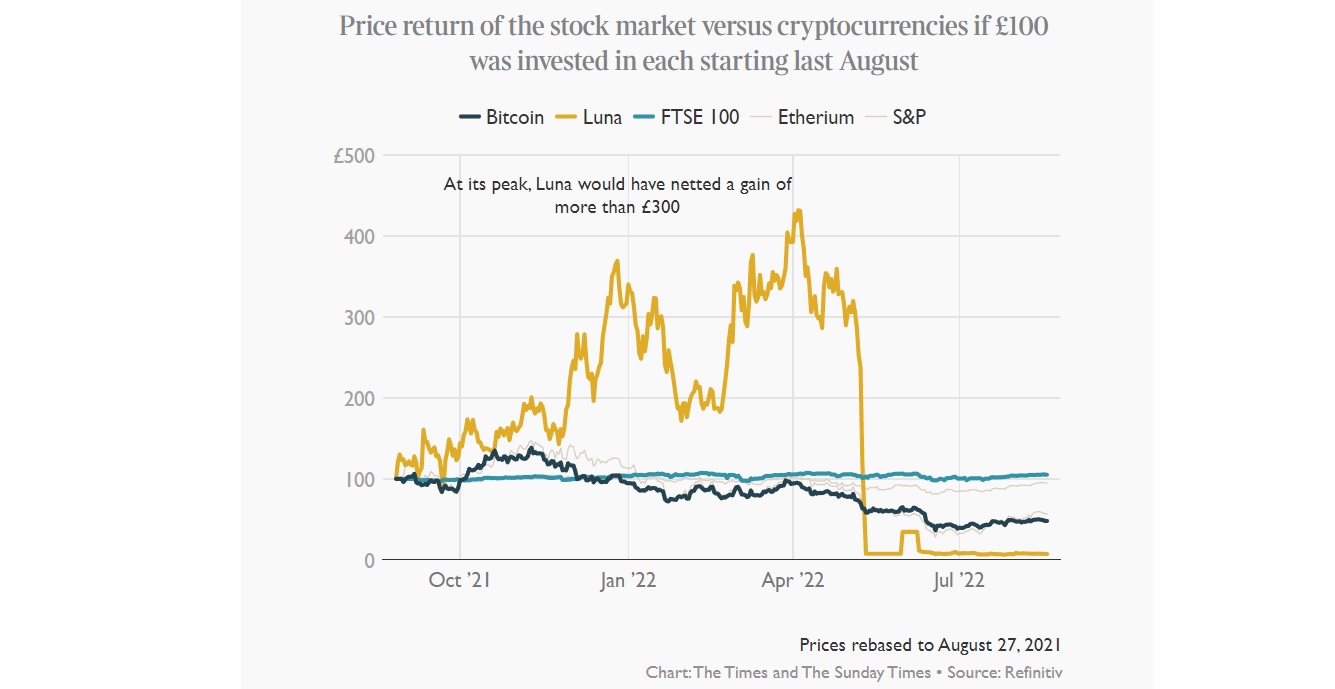
Terra and Luna collapsed. The next domino to fall was Three Arrows Capital, a Singapore hedge fund, one of the biggest crypto investors in the world. It had borrowed $670 million from Voyager, a publicly traded crypto lender from Canada that had lured in more than 3.5 million customers with promises of safe, steady, outsized returns.
Three Arrows used Voyager’s money to make huge bet on Luna just weeks before it crashed and defaulted in June. Creditors have been left to pick through the wreckage, which includes a $50 million down payment, 2 co-founders made on a super-yacht that was due to be delivered to them in Italy this summer. The Three Arrows meltdown created a huge problem for Voyager. With crypto prices in freefall, customers began yanking their money out. Voyager couldn’t meet the requests because the money it lent to Three Arrows was gone. It abruptly froze customer withdrawals last month and filed for bankruptcy.
Alex Mashinsky of Celsius was attempting to avoid a similar fate. Mid-June Celsius froze withdrawals and filed for bankruptcy protection. Mashinsky has not been heard from since. Three Arrows' Su Zhu and Kyle Davies, both 35, went into hiding before surfacing in an interview with Bloomberg last month. Even then they declined to reveal their location, citing death threats.
With hindsight it is hard to believe the edifice remained upright for so long. NYU’s Romer says: “Elements of this look very familiar — these guaranteed high rates of return: this is just pure Bernie Madoff. Despite all of the New Age sophistication and tech wizardry, this is all pretty garden variety stuff.” Ewan Kirk, a Scottish tech investor and former hedge fund manager, reflects the views of many: “It was just a giant fleecing of ordinary people.”
The Celsius bankruptcy may serve as a watershed moment because for most retail investors it was platforms such as Celsius and Voyager that served as the on-ramp to the crypto highway. The bankruptcy judge overseeing the case has been flooded with hundreds of letters from customers from Belgium to Brazil, Australia and beyond. Some lost their life savings. “The actions of Mr Mashinsky have created unspeakable misery for many people and I am sure will result in suicides. I’m crying as I write this and feel sorry for us all.” David Adler, a bankruptcy attorney in New York who is representing several customers, said that the outpouring was unprecedented in a bankruptcy proceeding. “I’ve never seen anything like this,” he says. “You can rest assured the judge is reading every single letter.”
So, was it all just a hill of magic beans, sautéed in technobabble? In the midst of a $2 trillion meltdown, it is hard to argue otherwise. Indeed, subject even the savviest crypto investor to a basic interrogation of how blockchain or cryptocurrencies will meaningfully improve a process or a service, and it swiftly devolves into generalities.
Liron Shapira, a noted crypto sceptic and tech investor, calls this crypto’s “hollow abstraction”.
He explains: “There is a specific human flaw where somebody will explain something to you abstractly, you’ll feel it click and you’re, like, ‘I get this.’ But actually it’s hollow. And the reason it’s hollow is because you didn’t unpack the abstraction and get into specifics.” The believers, of course, disagree. We are simply too early, they say. Just because it doesn’t work yet doesn’t mean it won’t work. Marc Andreessen, the billionaire venture capitalist who is also one of the single biggest backers of crypto start-ups, famously said of the dotcom boom: “Every failed idea from the dotcom bubble would work now.” Might this apply, at some future date, to crypto? Perhaps.


