The cases of Baltic Horizon Fund and EfTEN Real Estate Fund IIIThe COVID-19 pandemic is hurting businesses worldwide, and Baltic Horizon Fund (‘BHF’; ‘NHCBHFFT ET’), as well as EfTEN Real Estate Fund III (‘EfTEN’; ‘EFT1T ET’ (jointly referred to as the “Funds”), are also feeling the heat. Both Funds have cautioned about the impact of the COVID-19 crisis as it is putting pressure on tenants, especially within the retail and office sectors.
This is confirmed by the Colliers International Q2 2020 Baltic property market report published on 10th July 2020, which states that:
• Q2 2020 saw the completion of several new office projects in the Baltic states. These new entrants into the market further contributed to an increase in vacancy levels and left tenants in a stronger position to negotiate.
• The effect of COVID-19 on the retail market continued to linger following a sharp collapse in both footfall and turnover as a result of the lockdown. The changed spending habits of consumers are likely to continue to have a more significant impact on secondary shopping centres, especially in Vilnius, where vacancies could continue to rise.
Overall, though, the outlook is still uncertain, especially in terms of business survival in the Baltic states. This would impact the property market, with market participants indicating that they are preparing for the next the COVID-19 wave that is expected to hit in autumn. In order to insure against this, market participants are incorporating additional clauses into new and existing agreements. This is particularly the case for retailers, who are trying to negotiate turnover-based rental rates in the case of another outbreak.
Tale of Two Funds Both Funds took decisive action to limit the impact, including providing tenants with temporary relief and seeking debt relief. BHF has even opted to retain the H1 2020 distributable cash flow of EUR 2.7m so as to protect and strengthen its financial position. EfTEN’s management stated that the negative economic impact of the Covid-19 crisis, though, has been smaller than the management had initially anticipated. It has stated that this was partially due to:
• the diversified nature of the property portfolio in terms of sectors and countries;
• the strong tenant base;
• its good capitalisation; and
• its conservative financing strategy.
In light of the situation, though, both Funds had a downward revision to their property portfolio value at the end of June 2020.
• BHF’s valuation was performed by Newsec Baltics. The result was a 4.4% or EUR 15.7m drop in the fair value of the portfolio to EUR 345.5m. This valuation loss was attributed to downward revisions to valuation assumptions brought on by the coronavirus crisis. In particular, Newsec Baltics adopted higher discount rate assumptions (+0.3%) and lower cash flow projections compared to the previous valuations. The exit yields assumptions, though, remained unchanged due to a lack of comparable market deals during the lockdown.
• Colliers International did the valuation of EfTEN’s property portfolio. While the yields as an input to the property valuations did not change for any investment property, the discount rates for most of the properties were increased by 0.3pp due to the expected rise in interest rates. However, the valuation took into consideration a lower cash flow forecast, which had a more pronounced effect on the portfolio value. Colliers International has estimated that the rental income could decline by c.a. 4% from its normal level and, based on these assumptions, the value of EfTEN’s real estate portfolio has decreased by 3.1% or EUR 4.0m.
The Funds may be considered comparable in the sense that they are both Baltic property funds, but there are some distinct differences between the two.
EfTEN is better diversified in terms of segments, especially during the pandemic period. The retail and leisure segments have potentially been hit the hardest during the crisis, while EfTEN has the added advantage of the logistics segment. BHF’s retail segment has faced some write-downs on its retail properties and increased vacancy rates.
Likewise, there is a difference in the tenant structure of the Funds, with EfTEN’s largest tenants being DSV Transport AS (10.2%), DSV SIA (7.2%), and DSV Transport UAB (7.0%), and others including airBaltic, ABC Motors, and Hortes. Comparatively, BHF’s main clients are large tenants, including Rimi Baltic (9.4%), Latvian State Forestry (5.4%), Forum Cinemas (4.5%), G4S (4.3%), and SEB (4.2%). However, in many ways, large tenants could prove to be equally detrimental as at the time of the crisis can be more demanding than smaller tenants and less flexible in meeting mutually agreeable arrangements during the pandemic.
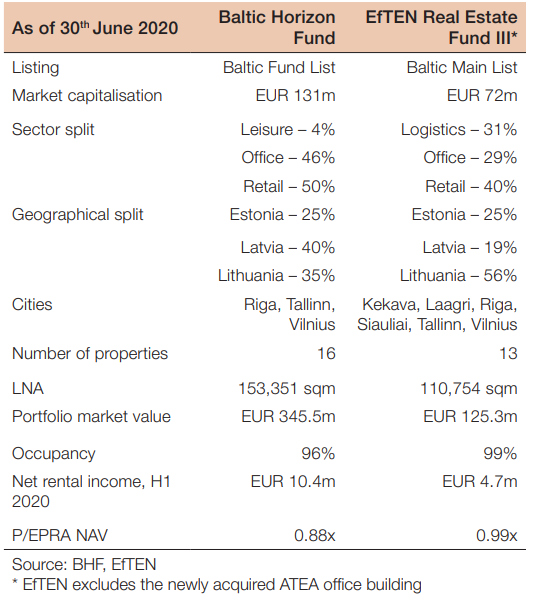
In terms of the property portfolios, BHF is the larger fund with 16 properties in its portfolio and a total net leasable area (‘NLA’) of 153,351 sqm. With a value of EUR 345.5m, this would imply an average value of c.a. EUR 2,250/sqm. Comparatively, at the end of H1 2020, EfTEN’s portfolio included 13 properties with an NLA of 110,754 sqm, with an implied average value of c.a. EUR 1,130/sqm. That said, with different independent valuators, it may sometimes be the case that it is difficult to compare the two funds on a likefor-like basis.
In terms of the Funds’ EPRA NAV value, under current market conditions, BHF and EfTEN are priced at P/EPRA NAV multiples of 0.88x and 0.99x, respectively. These are both priced higher than the peer median multiple (based on 30th June 2020 EPRA NAV values) of 0.75x. However, the Funds adopt different valuation methods and valuators, which somewhat limits the comparability of the EPRA NAV value.
Additionally, these two funds differ financially with regards to:
1. Annual NOI to book value – the NOI to book value for EfTEN is 7.5% compared to 5.9% for BHF.
2. Financing – EfTEN amortises its loans monthly (i.e. makes bank loan principal payments) whereas BHF has bullet loans with only monthly interest paid (i.e. no monthly principal repayments) and corporate bonds.
3. Dividend yield – as a result of the above, EfTEN has lower cash flows available for distribution compared to BHF.
Financial Considerations In H1 2020, EfTEN recorded revenues and EBITDA of EUR 4.9m (H1 2019: EUR 4.6m) and EUR 3.8m, respectively, despite the COVID-19 crisis. EfTEN explained that its EBITDA had increased annually by EUR 0.3m due to the addition of airBaltic’s office building and Kekava logistics building while the addition of the newly built Tähesaju Hortes provided an incremental EBITDA of EUR 0.2m. However, EBITDA was also adversely affected by EUR 0.2m as a result of the Covid-19 crisis, which necessitated temporary discounts that will end no later than September 2020. Due to the EUR 4.0m revaluation loss, EfTEN ended H1 2020 with a loss of nearly EUR 1.1m.
This was followed by strong July 2020 revenues of EUR 860k – the highest single month revenue for the year – and EBITDA of EUR 699k. EfTEN explained that this was supported by the post-crisis recovery from the Saules Miestas shopping centre and the reduced vacancies in the Evolution office building.
In July 2020, the temporary discounts on the DSV’s logistics buildings and the Hortes Horticultural Centers continued. It is estimated that these discounts cost EfTEN c.a. EUR 65k. It is expected that rental income will return to normal from August and September of this year.
More recently, EfTEN announced that it had acquired the ATEA headquarters in Vilnius for EUR 11.8m, including EUR 4.5m from equity and the balance from a loan issued by SEB bank. This takes the property portfolio to 14 and extends the gross leasable area by a further c.a. 6,800 sqm. This is likely to add value to EfTEN and provide additional revenues.
Based on the factors mentioned above, we expect total revenues to reach EUR 10.6m in 2020. However, due to the revaluation loss in June 2020, we estimate that the net profit could drop from EUR 7.7m in 2019 to EUR 2.5m in 2020. With an assumption that revenues would normalise to EUR 11.6m and there might be a EUR 1.1m revaluation gain, the net profit could increase to EUR 7.8m in 2021.
