Huvitav mõte Gerri Kodreselt. Kui Skeleton lendu tõuseb, võiks see luua Skype-efekti kogu kohaliku teaduspõhise ettevõtluse jaoks.
"Keerukustasemelt järgmised ongi teadusmahukad või teadus- ja arendustegevusel põhinevad iduettevõtted, mis vajavad palju rohkem aega ja raha, et tootega turule jõuda. Õnnestumiseks on tarvis nii spetsiifiliste oskustega ettevõtjaid ja töötajaid, investoreid, kellel oleks piisavalt vahendeid ja kannatust kui ka tugisüsteeme.
/.../ Väga oluline tegur selle juures, et teatud valdkond hoo üles võtaks, on esimese suurema eduloo ehk tšempioni teke, nagu meil kunagi oli Skype kogu start-up-valdkonna katalüsaatoriks. Kui tarkvaraäris on sellised eeskujud meil ammu olemas ja riistvara tarkvaraga kombineerivas segmendis on neid viimastel aastatel tekkinud, siis nüüd on ka teadusmahukas segmendis esimesed tšempionid esile kerkinud, näiteks Skeleton Technologies. Kui selline eeskuju tekib, on kõik eeldused olemas, et eksperiment käima läheks."
https://www.foundme.io/uudised/2021/03/26/gerri-kodrese-kristallkuul-need-idufirmad-toovad-jargmise-kasvu
Youtube soovitas mulle juhuslikult ühe 277k tellijaga kanali videot ja minu üllatuseks hakati seal kiitma Skeleton Technologies püüdlusi saavutada läbimurret oma valdkonnas ja poetati isegi Eesti kohta reisisoovitus.
Harju Elektri hinnast on vist suht pühitud see Skeletoni potensiaal. No näis, mis nende saatus saab olema tulevikus.
Graphene SuperCapacitor Breakthrough Is FINALLY Here!
https://www.youtube.com/watch?v=87o8AIldbh4&ab_channel=TwoBitdaVinci
Harju Elektri hinnast on vist suht pühitud see Skeletoni potensiaal. No näis, mis nende saatus saab olema tulevikus.
Graphene SuperCapacitor Breakthrough Is FINALLY Here!
https://www.youtube.com/watch?v=87o8AIldbh4&ab_channel=TwoBitdaVinci
Skeleton ehitab 2024. aastaks 220 miljoni euro eest Saksamaal uue tehase, mis vähendab tootmiskulusid 90%. Koostöös Siemensiga. Minu tõlgendus on, et selles tehases hakkab massi-/seeriatootmine.
On olnud uudiseid varem:
12 märts 2021
"Eesti energiasalvestustehnoloogia tootja Skeleton Technologies teatas reedel, et sai Saksamaalt 51 miljoni euro suuruse toetuse. Raha on ette nähtud Skeletoni Saksamaal asuva Grossroehrsdorfi tehase automatiseerimiseks."
https://www.err.ee/1608140506/saksamaa-toetab-eesti-tehnoloogiafirmat-skeleton-51-miljoni-euroga
30 august 2021
Skeleton ehitab Saksamaale uue tehase
https://www.aripaev.ee/uudised/2021/08/27/skeleton-ehitab-saksamaale-uue-tehase
Tänane uudis tundub mujal olla sõnastatud "Siemens designed" tehas.
Mind paneb siiski mõtlema, et kui tootmiskulud väheneksid 90%, kas siis tootmine siiamaani on olnud pigem test...
12 märts 2021
"Eesti energiasalvestustehnoloogia tootja Skeleton Technologies teatas reedel, et sai Saksamaalt 51 miljoni euro suuruse toetuse. Raha on ette nähtud Skeletoni Saksamaal asuva Grossroehrsdorfi tehase automatiseerimiseks."
https://www.err.ee/1608140506/saksamaa-toetab-eesti-tehnoloogiafirmat-skeleton-51-miljoni-euroga
30 august 2021
Skeleton ehitab Saksamaale uue tehase
https://www.aripaev.ee/uudised/2021/08/27/skeleton-ehitab-saksamaale-uue-tehase
Tänane uudis tundub mujal olla sõnastatud "Siemens designed" tehas.
Mind paneb siiski mõtlema, et kui tootmiskulud väheneksid 90%, kas siis tootmine siiamaani on olnud pigem test...
Lisan tänased pressiteated.
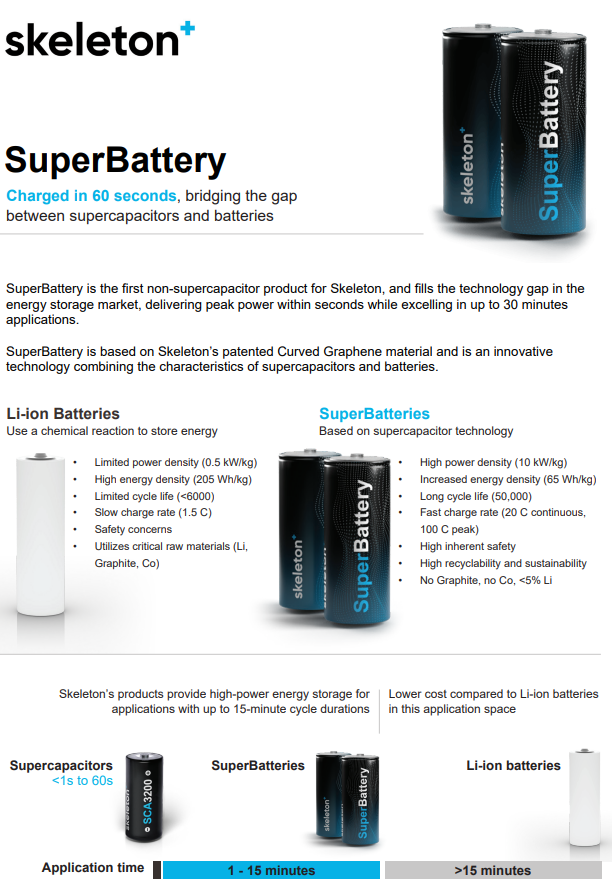
Täna rääkisid kõik Shelliga koostööst, kuid tegelik uudis tundub olevat see, et Skeleton teatas SuperBattery toote lansseerimisest ja avalikustas oma varasemalt välja reklaamitud arendusjärgus toote turuküpseks saamise: Skeleton launches its SuperBattery and unveils Shell as partner
Shelli pressiteade: Shell builds a winning consortium to accelerate the electrification of off-road mining vehicles
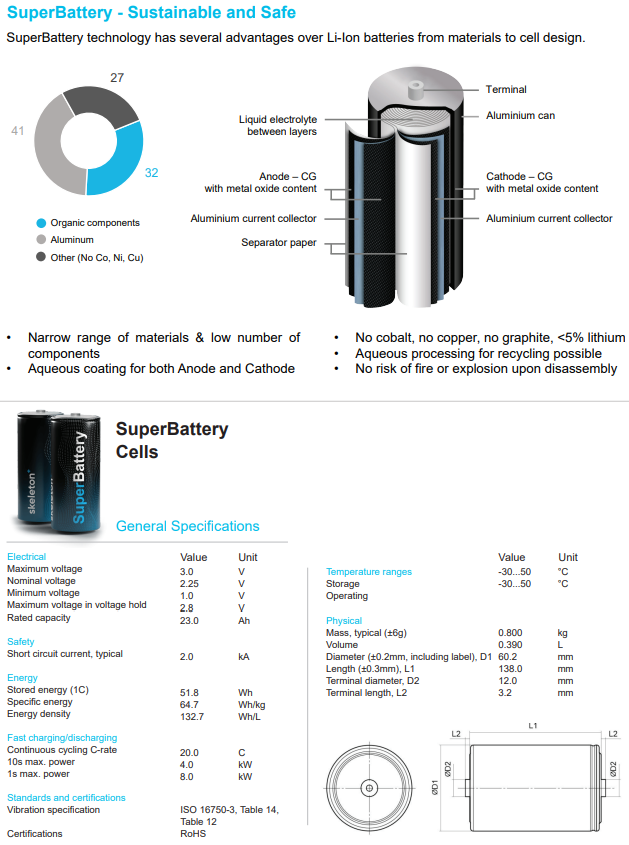
SuperBattery on Skeletoni olemasoleva curved graphene tehnoloogia edasiarendus sellisel viisil, et säilivad olulises mahus superkondensaatorite senised positiivsed küljed (ei sisalda haruldasi metalle, ei pea kaevandama palju, element on lihtsalt taastöödeldav ja utiliseeritav, laeb kiiresti täis ja tühjaks, saab palju kordi laadida, ei põle ega plahvata), samal ajal aga adresseerib superkondensaatorite peamist valupunkti, ehk power density on alati väga kõva olnud (annab korraga väga palju võimsust välja), aga energy density on alati väga nadi olnud (ehk selle suure võimsusega ei sõida pikka distantsi). Nüüd siis SuperBattery tootega ka energy density tõuseb, ja toodet saab kasutada oluliselt pikema perioodi jooksul energia saamiseks.
Järgnevalt ametlik brośüür:
Kontekstiks ja võrdluseks.
Siit 2018. a. artiklist võrdluseks üks joonis, kuidas power density ja energy density omavahel erinevates tehnoloogiates seoses on (NB! skaalad logaritmilised):
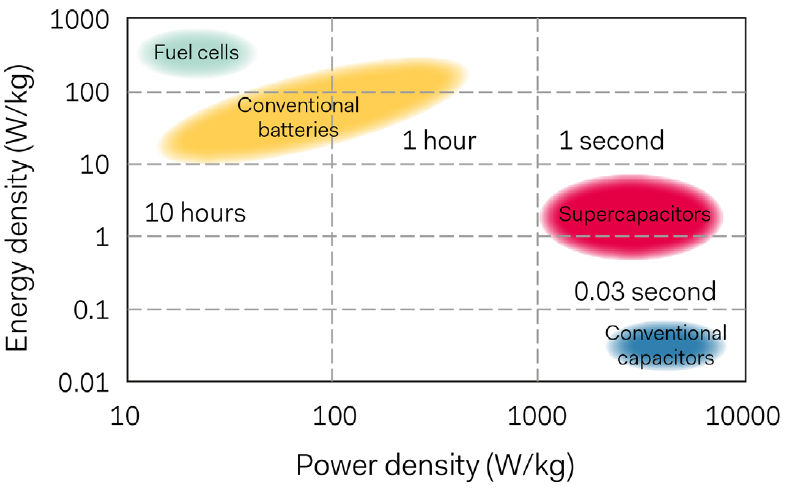
Peamine point siin selles, et superkondensaatorite energy density on alati väga madal olnud, ca 1...10 vahel, samal ajal kui patareidel 10...100 vahel.
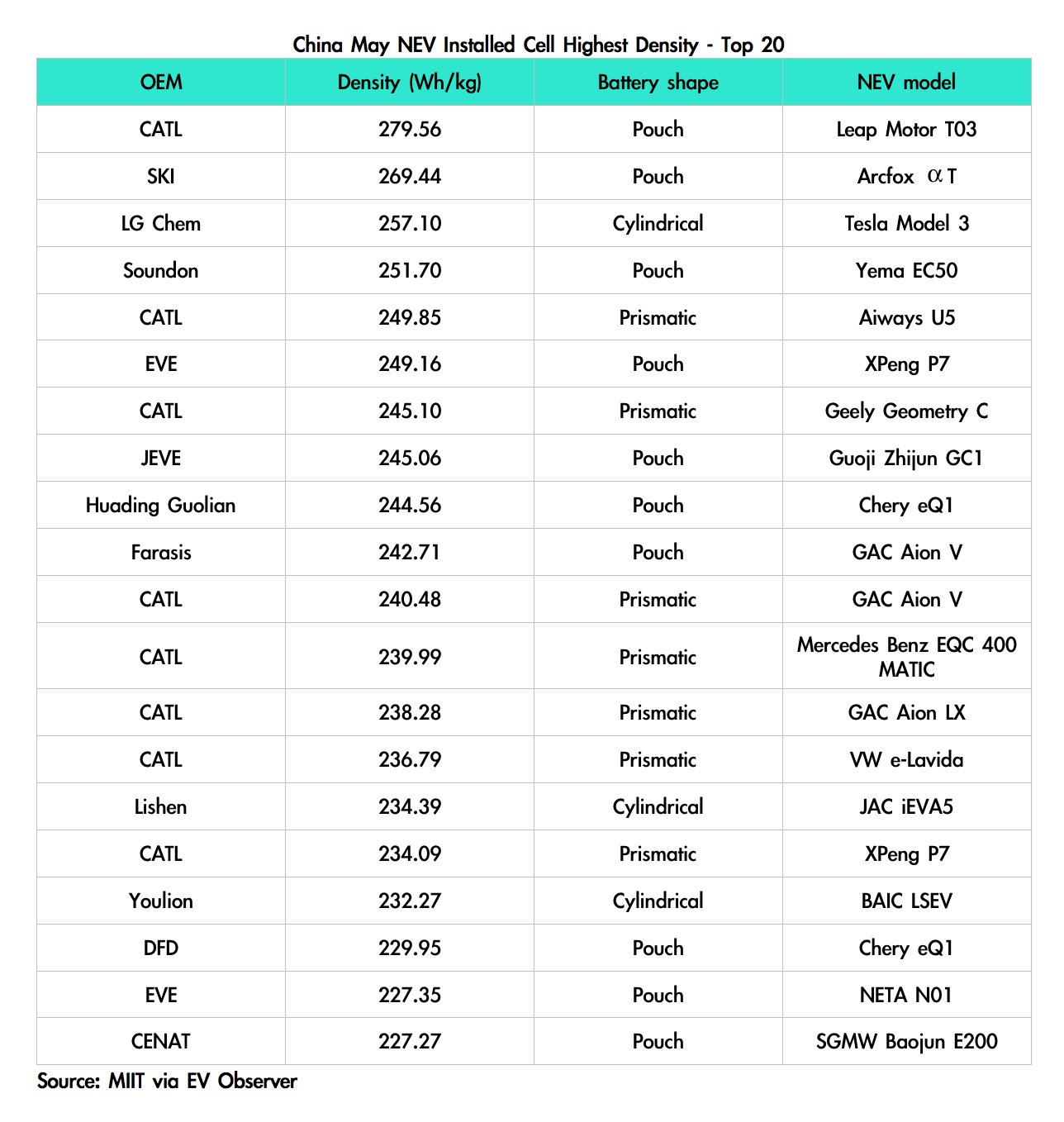
Enamus firmasid maailmas toodab akusid, mitte superkondensaatoreid. Seega Skeleton on superkondensaatorite maailmas parim tegija, aga praegu tuleb võrrelda akude jõudlust, sest Skeletoni eesmärk on akud maailmast täielikult välja süüa. Võrreldes 2018 aastaga on akude olukord natuke parem - kommertsvalmidusega aku-toodete tipptegijad on ca 200+ juures:
Sektori suurtegija CATL näeb kaugemas tulevikus 350...500+ maailma jõudmist:
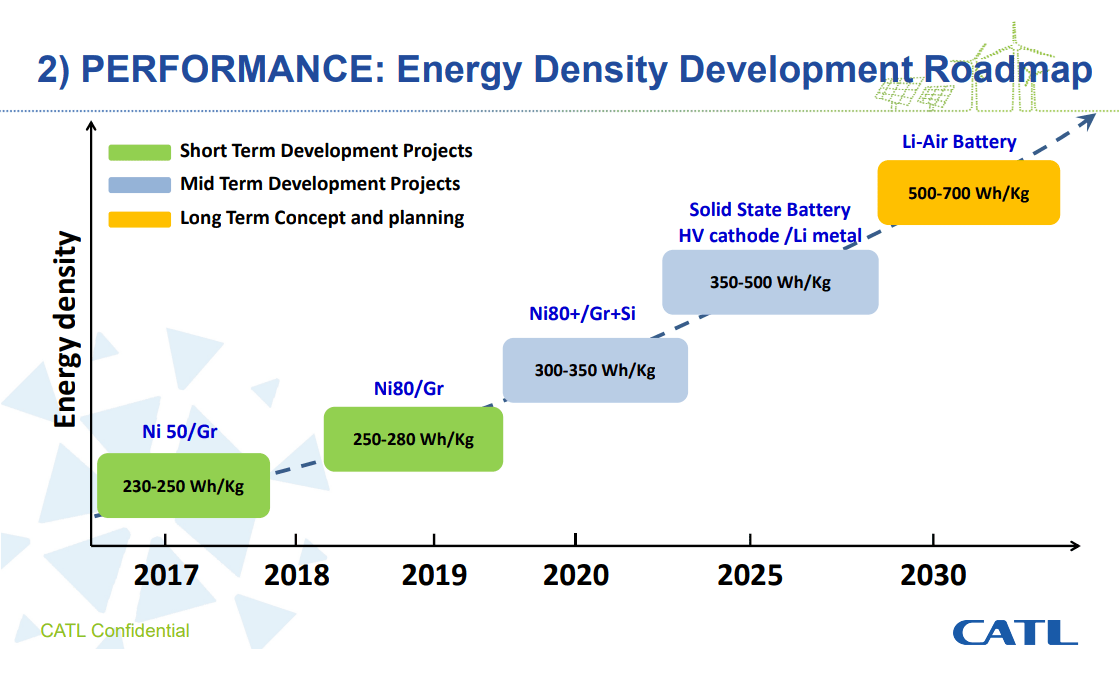
Aga ega ka Skeleton ei maga. Küll nemadki oma uusi tooteid välja toovad ja näitajaid parandavad. Kui superkondensaatorite tööaeg pikeneb ja samal ajal positiivsed aspektid säilivad, siis kartma peavad akud ja mitte superkondensaatorid. Kui keegi turuosa kaotab, siis need on akud.
Akude energiatiheduse kasv pole lähiajal olnud revolutsiooniline, vähemalt BNEF kogutud andmete põhjal:
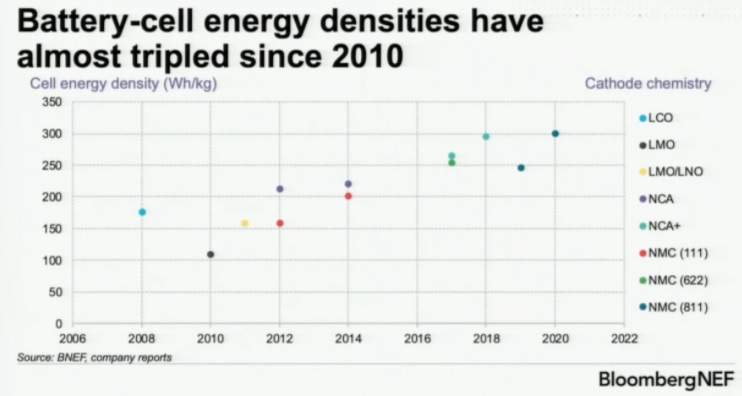
2010 --> 2020 = 200 Wh/kg --> 300 Wh/kg = kümne aastaga +50% kasvu = siin küll CAGR suur ei saa olla!
Yahoo! Finance annab CATL, Contemporary Amperex Technology Co., Limited (300750.SZ) valuatsiooniks igati rasvase kasvuaktsia:
* mcap 978 miljardit jüääni, ehk 136.3 miljardit USD.
* trailing P/E 47.67
* Forward P/E 34.72
* Price/Sales 4.70
* Price/Book 7.00
* EV/Revenue 4.51
* EV/EBITDA 25.27
Võttes arvesse, et see on täielik kolakas oma 150b turuväärtusega, siis näitab suure ettevõtte kallilt hinnastamine ainult seda, et igasugused elektrifitseerimise energialahendused on investoritele huvitavad, seda isegi käimasolevat "turukrahhi" ja "majanduskriisi" arvesse võttes. (CATL muidugi on ka oma sektori liider-ettevõte ja müüb toodangut paljudele autotootjatele ja seetõttu saab kõva kordajat õigustada.)
CATL pikk graafik:
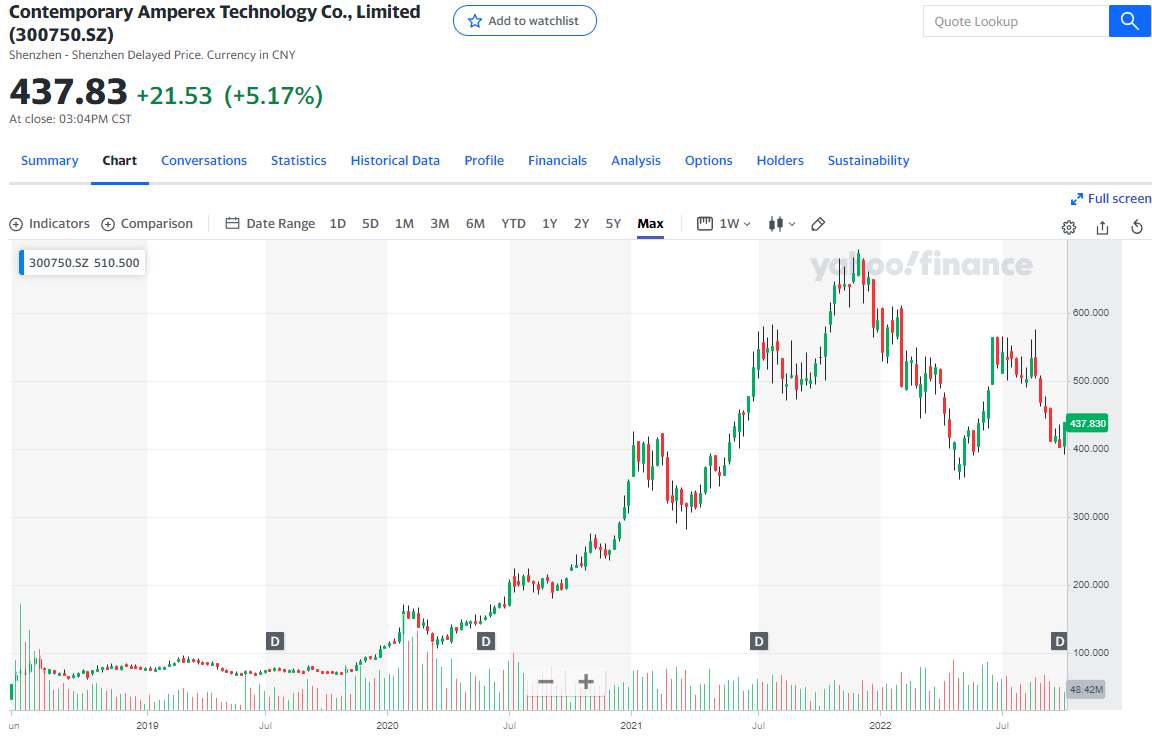
Läks koos EV levikuga ja akude tootmisega suurde buumi. Korra koos turuga kukkus 2022 algusest peale, siis aga põrkas jälle jõuliselt. Nüüd jälle kukkunud, aga samas jälle valmistumas põrkeks. Samal ajal kui ARKK invest tüüpi kasvuaktsiad on kukkunud ja jäävadki maha.
Communications materials publikatsioonis avaldatud prognoosid erinevate elektriauto patareide toormete kohta: Future material demand for automotive lithium-based batteries
Ainuüksi elektrifitseerimine elektriautode akude jm. tõttu tähendab tohutut turumahu kasvu akude tootjatele. Toodangu valmistamiseks aga on vaja avada suures koguses uusi kaevandusi. Skeletoni toodangule hakkab nõudlus tekkima ainuüksi selle tõttu, et kui on akude tootmiselt võimalik ressurssi säästa, siis võetakse alternatiiv nendeks funktsioonideks (mingid lühiajalised elektritarbimised), kus vähegi on võimalik alternatiiv kasutusele võtta. Vastasel korral pole võimalik akusid nii palju toota, kui oleks nõudlust.
Tänase uudise põhiline sõnum on, et SuperBattery arendus on valmis jõudnud/valmimas ja see tuleb turule. Kliendi (Shell) ja kasutusala (suurte kaevandusveokite liigutamine) nimetamine aga valideerib toote vajalikkuse turu jaoks kohe algusest peale. See pole toode, millele tuleb hakata kasutusala leiutama. See on toode, millel on nõudlus olemas kohe algusest peale. Ja hea on, et kohe esimese kliendi kasutusnäide on maailma suurimate sõidukite agressiivne ekspluateerimine rasketes oludes - ega siit edasi kõik ülejäänud kasutusalad ja kliendid saavad Skeletoni jaoks ainult kergemaks minna.
Tõenäoliselt nad peavad nüüd rohkem tehaseid ehitama, kui ülejäänud kaevandajad ka oma kaevandusi CO2 neutraalseks soovivad tuunima hakata ja samuti tellijate ringi astuvad.
Kui Shell on CO2 emissiooni kärpimise vajadusest tulenevalt valmis ostma "akusid", mille tööaeg on ainult 30 minutit, siis on dekarboniseerimise ja rohestamise tung ka teisi ettevõtteid tagant ajamas. Alustame 30min pealt, tulevikus uued versioonid tootest viivad ehk tööaja 3h peale ja enamusele inimestest sõidukite puhul tegelikult 3h tööajast juba piisab, et järgmise laadimiskohani jõuda.
Berlin, Germany – 12th October 2022: Skeleton Technologies, the global technology leader in fast charging for transportation, grid, automotive, and industrial applications, is today delighted to officially launch its SuperBattery, and to unveil Shell as partner. Skeleton is joining a Shell-led consortium to offer electrification solutions for mining sites.
SuperBattery is an innovative technology combining the characteristics of supercapacitors and batteries. SuperBattery has been developed to serve the needs of several sectors and is currently being used and/or tested in hybrid and fuel cell EVs, buses, trucks, and charging infrastructure.
Taavi Madiberk, CEO and co-founder of Skeleton Technologies, says:“Skeleton goes after the high-power part of the energy storage market and we estimate the addressable market size to be 95 Bn EUR. Now, the key is to move ahead with the scale-up and we aim to develop our business around SuperBattery through key partners such as Shell."
Decarbonization in mining largely relies upon electrification and renewables, which are the best way to reduce operational emissions. Electrification of heavy-duty applications is both a necessity and a major challenge for the mining industry.
Grischa Sauerberg, Vice President, Sectoral Decarbonisation and Innovation at Shell explains: “The challenge of decarbonisation is immense, but not impossible – providing collaboration and innovation go hand in hand at all times. We are proud to work alongside Skeleton - and our consortium members - to develop a new pilot offering of electrification solutions for off-road vehicles and to demonstrate how partnership and close collaboration can help mining businesses meet their environmental goals. Skeleton’s technology, providing ultrafast charging at ~< 90 seconds, means the solution can help mining companies reduce emissions without compromising on efficiency.”
The nine-member consortium, including Skeleton and Shell, has come together to introduce Shell’s Mining Electrification Solutions for Off-Road Vehicles – announced in May 2022 as one of the 8 winners of the mining industry’s ‘Charge On Innovation Challenge’, from over 350 entries. The solution is an end-to-end and interoperable electrification system that reduces emissions without compromising on efficiency or safety, whilst aiming to be cost competitive versus diesel-powered operations. The pilot offering combines ultra-fast charging with Skeleton’s new SuperBattery, in-vehicle energy storage, and power provisioning and microgrids.
Taavi Madiberk continues: “Over the next 7 years, the mining sector represents a multi-billion revenue opportunity for Skeleton. This is not only driven by decarbonization, but by tangible economic benefits for our customers. Skeleton is focused on reducing emissions in hard-to-decarbonize sectors. But we cannot achieve it alone, we can only do it with partners. Close collaboration with Shell is key for us, with potential going way beyond mining applications.”
The haul truck is not the only electrification effort in the mine - energy storage such as SuperBattery can also be used in stabilizing the grid of mines or to electrify wheel loaders and other machinery. The drive for high safety and power combined with high lifetime makes an optimal use profile for SuperBattery.
SuperBattery combines several advantages which make it a perfect fit for Shell’s Mining Electrification Solutions for Off-Road Vehicles. Skeleton’s patented Curved Graphene material allows for 100 x faster charging compared to standard Lithium-ion batteries. Used in off-road vehicles, SuperBattery can be charged in less than a minute, therefore requiring much less charging time spent per day: less than an hour, whereas 6.5 hours are needed with a lithium-ion battery. More time can therefore be spent on mining, and less on charging. SuperBattery has 50,000 life cycles, and is free from cobalt, copper, nickel, and graphite. It is also much safer than a lithium-ion battery, even when crushed, overheated, or pierced.
SuperBattery fills the technology gap in the energy storage market, delivering peak power and fast charging, and is best suited for applications below 30 minutes because of lower cost and footprint. The start of mass production is planned for 2024.
Disclaimers:
End to End solution: Shell supplies the electricity to the OEM vehicle as well as facilitating the implementation and operations of an electrified haul-truck fleet. Solutions include: next generation in-vehicle energy storage, high-capacity fast charging systems, automated charging connectors, microgrid site energy management, mine-site integration specialist and renewable power provisioning.
Reduce emissions: Electrified mobile equipment does not emit any CO2 emissions whilst operational and therefore offers a reduction vs. diesel operated machinery.
Without compromise in operational efficiency: Shell's electrification solution can have multiple charge points available to charge a haul-truck within a typical haul-truck cycle whilst a vehicle is typically stationary, such as whilst being loaded, meaning a haul-truck may run continuously.
Without compromise on safety: For Shell, HSSE is a key priority when designing individual components of the solution and integrating them in a system. For example, HSSE safeguards such as on-board & Remote Emergency Stop, Object Detection and Avoidance, Charge Connector Status, Temperature & Coolant Flow Monitoring aim to be implemented. Ultracapacitors that we intend to use for energy storage have better fire safety characteristics than Lithium-ion batteries.
Ultra-fast charging: Ultra-fast means Energy Transfer of 400 kWh in ~< 90 sec and assumes peak power delivery of 24MW.
Electrification has lower TCO (vs. diesel): TCO is calculated using a variety of factors including cost of maintenance and the cost of energy (electricity). This is dependent on the cost of electricity, availability of electricity supply to a mine site and the cost of implementing an electric fleet.
Interoperability: Shell is working with Original Equipment Manufacturers (OEM) and solution provider partners to standardise our solution specifications across multiple OEMs and solution providers to ensure a broad as possible compatibility.
Renewable Power: Renewable power refers to electricity generated from renewable sources like wind or solar. Renewable power generation is not possible in all situations.


Shelli pressiteade: Shell builds a winning consortium to accelerate the electrification of off-road mining vehicles
London: Today, Shell announced the establishment of its nine-member consortium to create a new pilot offering of electrification solutions for mining sites. Skeleton, Microvast, Stäubli, Carnegie Robotics, Heliox, Spirae, Alliance Automation, Worley and Shell have come together to introduce Shell’s Mining Electrification Solutions for Off-Road Vehicles – an end-to-end and interoperable electrification system that reduces emissions without compromising on efficiency or safety, while aiming to be cost competitive versus diesel-powered operations. The pilot offer combines an innovative, high-powered battery solution with ultrafast charging and a standardised micro-grid energy system where the required solution can be complemented with renewable electricity generation on-site or through the grid.
As an alternative energy source, electrification offers off-road industries the immediate potential to shift away from a long-standing reliance on diesel. For hard-to-abate sectors like mining, this is critical, since mobile equipment comprises between 40 and 50 per cent of mining’s CO2 emissions.1 By 2030, it is estimated that a battery-electric haulage truck will: lower total cost of ownership (TCO); involve 20 per cent lower maintenance costs; and incur 40 per cent lower fuel costs than existing diesel trucks.1
“It is increasingly clear that no one, single organisation can solve decarbonisation alone,” said Grischa Sauerberg, Vice President, Sectoral Decarbonisation & Innovation at Shell. “The need for a collaborative effort is particularly evident within carbon-intensive industries like mining, where the challenges are great but the opportunities are even greater. To overcome these challenges and unlock these opportunities, Shell is helping to bring together some of the sector’s most innovative companies – with electrification proving an important first step towards the shaping of a clear decarbonisation pathway.”
Shell’s Mining Electrification Solutions for Off-Road Vehicles consists of:
* Power provisioning and microgrids: aim to provide a consistent and reliable supply of renewable power in a safe and stable manner
* Ultra-fast charging: taking approximately 90 seconds via flexible, hardwearing and resilient, on-site, ultrafast charge-points, which provide assets with continuous operations in the most challenging of environments
* In-vehicle energy storage: through a combination of advanced battery and capacitor technologies that aim to deliver long lifetimes, ultra-fast charging and high performance.
As a result, mining operators are set to benefit from an integrated electrification solution that:
* Is end-to-end, covering the full journey of the electron from generation to delivery in the drive train
* Is interoperable between different Original Equipment Manufacturer (OEM) make and models, giving mining operators greater flexibility
* Is modular in design to allow mining customers the opportunity to tailor solutions to their specific needs
* Reduces emissions without compromising on operational efficiency or safety
“The challenge of decarbonisation is immense, but not impossible – providing collaboration and innovation go hand in hand at all times,” said Sauerberg. “Both of which were on show during the recent Charge On Innovation Challenge, which saw the Shell-led consortium of equipment manufacturers, technology partners, industry experts and Shell Energy – our in-house supplier of renewable power - push the boundaries of what is possible for hard-to-abate sectors like mining. Our winning solutions are proof of how, together, the industry can help power progress by realising the full potential of the technologies available to us – whether that is through electrification, digital tools or low-carbon fuels.”
As Shell works together with customers and partners towards a new, cleaner era for mining, it is important to attract leading companies from other sectors of the economy who also want to make a positive contribution to reducing emissions.
SuperBattery on Skeletoni olemasoleva curved graphene tehnoloogia edasiarendus sellisel viisil, et säilivad olulises mahus superkondensaatorite senised positiivsed küljed (ei sisalda haruldasi metalle, ei pea kaevandama palju, element on lihtsalt taastöödeldav ja utiliseeritav, laeb kiiresti täis ja tühjaks, saab palju kordi laadida, ei põle ega plahvata), samal ajal aga adresseerib superkondensaatorite peamist valupunkti, ehk power density on alati väga kõva olnud (annab korraga väga palju võimsust välja), aga energy density on alati väga nadi olnud (ehk selle suure võimsusega ei sõida pikka distantsi). Nüüd siis SuperBattery tootega ka energy density tõuseb, ja toodet saab kasutada oluliselt pikema perioodi jooksul energia saamiseks.
Järgnevalt ametlik brośüür:
Kontekstiks ja võrdluseks.
Siit 2018. a. artiklist võrdluseks üks joonis, kuidas power density ja energy density omavahel erinevates tehnoloogiates seoses on (NB! skaalad logaritmilised):
Peamine point siin selles, et superkondensaatorite energy density on alati väga madal olnud, ca 1...10 vahel, samal ajal kui patareidel 10...100 vahel.
Enamus firmasid maailmas toodab akusid, mitte superkondensaatoreid. Seega Skeleton on superkondensaatorite maailmas parim tegija, aga praegu tuleb võrrelda akude jõudlust, sest Skeletoni eesmärk on akud maailmast täielikult välja süüa. Võrreldes 2018 aastaga on akude olukord natuke parem - kommertsvalmidusega aku-toodete tipptegijad on ca 200+ juures:
Sektori suurtegija CATL näeb kaugemas tulevikus 350...500+ maailma jõudmist:
Aga ega ka Skeleton ei maga. Küll nemadki oma uusi tooteid välja toovad ja näitajaid parandavad. Kui superkondensaatorite tööaeg pikeneb ja samal ajal positiivsed aspektid säilivad, siis kartma peavad akud ja mitte superkondensaatorid. Kui keegi turuosa kaotab, siis need on akud.
Akude energiatiheduse kasv pole lähiajal olnud revolutsiooniline, vähemalt BNEF kogutud andmete põhjal:
2010 --> 2020 = 200 Wh/kg --> 300 Wh/kg = kümne aastaga +50% kasvu = siin küll CAGR suur ei saa olla!
Yahoo! Finance annab CATL, Contemporary Amperex Technology Co., Limited (300750.SZ) valuatsiooniks igati rasvase kasvuaktsia:
* mcap 978 miljardit jüääni, ehk 136.3 miljardit USD.
* trailing P/E 47.67
* Forward P/E 34.72
* Price/Sales 4.70
* Price/Book 7.00
* EV/Revenue 4.51
* EV/EBITDA 25.27
Võttes arvesse, et see on täielik kolakas oma 150b turuväärtusega, siis näitab suure ettevõtte kallilt hinnastamine ainult seda, et igasugused elektrifitseerimise energialahendused on investoritele huvitavad, seda isegi käimasolevat "turukrahhi" ja "majanduskriisi" arvesse võttes. (CATL muidugi on ka oma sektori liider-ettevõte ja müüb toodangut paljudele autotootjatele ja seetõttu saab kõva kordajat õigustada.)
CATL pikk graafik:
Läks koos EV levikuga ja akude tootmisega suurde buumi. Korra koos turuga kukkus 2022 algusest peale, siis aga põrkas jälle jõuliselt. Nüüd jälle kukkunud, aga samas jälle valmistumas põrkeks. Samal ajal kui ARKK invest tüüpi kasvuaktsiad on kukkunud ja jäävadki maha.
Communications materials publikatsioonis avaldatud prognoosid erinevate elektriauto patareide toormete kohta: Future material demand for automotive lithium-based batteries
The world is shifting to electric vehicles to mitigate climate change. Here, we quantify the future demand for key battery materials, considering potential electric vehicle fleet and battery chemistry developments as well as second-use and recycling of electric vehicle batteries. We find that in a lithium nickel cobalt manganese oxide dominated battery scenario, demand is estimated to increase by factors of 18–20 for lithium, 17–19 for cobalt, 28–31 for nickel, and 15–20 for most other materials from 2020 to 2050, requiring a drastic expansion of lithium, cobalt, and nickel supply chains and likely additional resource discovery. However, uncertainties are large. Key factors are the development of the electric vehicles fleet and battery capacity requirements per vehicle. If other battery chemistries were used at large scale, e.g. lithium iron phosphate or novel lithium-sulphur or lithium-air batteries, the demand for cobalt and nickel would be substantially smaller. Closed-loop recycling plays a minor, but increasingly important role for reducing primary material demand until 2050, however, advances in recycling are necessary to economically recover battery-grade materials from end-of-life batteries. Second-use of electric vehicles batteries further delays recycling potentials.


Ainuüksi elektrifitseerimine elektriautode akude jm. tõttu tähendab tohutut turumahu kasvu akude tootjatele. Toodangu valmistamiseks aga on vaja avada suures koguses uusi kaevandusi. Skeletoni toodangule hakkab nõudlus tekkima ainuüksi selle tõttu, et kui on akude tootmiselt võimalik ressurssi säästa, siis võetakse alternatiiv nendeks funktsioonideks (mingid lühiajalised elektritarbimised), kus vähegi on võimalik alternatiiv kasutusele võtta. Vastasel korral pole võimalik akusid nii palju toota, kui oleks nõudlust.
Tänase uudise põhiline sõnum on, et SuperBattery arendus on valmis jõudnud/valmimas ja see tuleb turule. Kliendi (Shell) ja kasutusala (suurte kaevandusveokite liigutamine) nimetamine aga valideerib toote vajalikkuse turu jaoks kohe algusest peale. See pole toode, millele tuleb hakata kasutusala leiutama. See on toode, millel on nõudlus olemas kohe algusest peale. Ja hea on, et kohe esimese kliendi kasutusnäide on maailma suurimate sõidukite agressiivne ekspluateerimine rasketes oludes - ega siit edasi kõik ülejäänud kasutusalad ja kliendid saavad Skeletoni jaoks ainult kergemaks minna.
Tõenäoliselt nad peavad nüüd rohkem tehaseid ehitama, kui ülejäänud kaevandajad ka oma kaevandusi CO2 neutraalseks soovivad tuunima hakata ja samuti tellijate ringi astuvad.
Kui Shell on CO2 emissiooni kärpimise vajadusest tulenevalt valmis ostma "akusid", mille tööaeg on ainult 30 minutit, siis on dekarboniseerimise ja rohestamise tung ka teisi ettevõtteid tagant ajamas. Alustame 30min pealt, tulevikus uued versioonid tootest viivad ehk tööaja 3h peale ja enamusele inimestest sõidukite puhul tegelikult 3h tööajast juba piisab, et järgmise laadimiskohani jõuda.
See ongi superkondensaatorite suurim väljakutse, et kuidas peatada isetühjenemine. Mida kauemaks sa aku seisma jätad, seda rohkem elektrit sa tegelikult raisku lased. Parim lahendus on siin ikkagi superkondeka ja Li aku kombo. Kondekas kiirelt täis, masin sõidab tööd tegema ja samal ajal laeb see kondekas 20 minutiga Li aku täis. Ja masin ei pea mitu korda tunnis laadimas käima.
Aga see on tõsi, et materjalipuudus paneb tootjaid arendustööd tegema. LFP akude võidukäik jätkub, nikkel ja koobalt hakkab akudest kaduma. Siis tulevad solid-state akud, kus neid materjale samuti vaja pole. Grafiiti toodetakse sünteetiliselt, looduslikku akutootjad sisuliselt enam üldse ei tahagi osta, sest see pole nii puhas. Vaske läheb paraku üha rohkem vaja, sest elektrimootorid vajavad seda ja siin ei aita ka superkondensaator maailma päästa. Elektriautos on ca 4x rohkem vaske kui SP-autos.
Kas superkondensaator asendab kunagi Li akud transpordisektoris, võimatu täna öelda. Eks ka nende omavaheline hinnakonkurents määrab siin palju, kui muud meetrikad võrdsustuma hakkavad. 800V Li aku laeb juba täna piisavalt kiiresti ja otsest vajadust sinna kondekas lisada ei ole. Kui siis paar-kolm kWh.
Aga pole kahtlust et peale autotranspordi on miljon muud kohta, kus norm hinnaga superkondensaatorit väga oodatakse ja see võib olla (Eesti) uus Nokia. Kahju et riik omal ajal maha magas selle võimaluse, ei aidanud rahastusega ja peletas Skeletoni Saksamaale.
"Esiteks, Saksamaa turg moodustab maailmaturust pea neljandiku ning hetkel pole seal kohalikku tootjat. Paljude ettevõtete jaoks on väga oluline logistiline lähedus ning kohalik inseneritugi," ütles ta sügisel.
"Teine faktor on väga hea kvalifitseeritud tööjõu kättesaadavus. Kolmas aspekt seisneb finantseerimistingimustes. Appi tuli meile Saxonian Development Bank, kes pani projektile õla alla," märkis Skeletoni kaasasutaja septembris.
Loe pikemalt: https://www.ituudised.ee/uudised/2017/03/28/skeleton-tehase-avamiseks-saksamaal-on-kolm-pohjust
Aga see on tõsi, et materjalipuudus paneb tootjaid arendustööd tegema. LFP akude võidukäik jätkub, nikkel ja koobalt hakkab akudest kaduma. Siis tulevad solid-state akud, kus neid materjale samuti vaja pole. Grafiiti toodetakse sünteetiliselt, looduslikku akutootjad sisuliselt enam üldse ei tahagi osta, sest see pole nii puhas. Vaske läheb paraku üha rohkem vaja, sest elektrimootorid vajavad seda ja siin ei aita ka superkondensaator maailma päästa. Elektriautos on ca 4x rohkem vaske kui SP-autos.
Kas superkondensaator asendab kunagi Li akud transpordisektoris, võimatu täna öelda. Eks ka nende omavaheline hinnakonkurents määrab siin palju, kui muud meetrikad võrdsustuma hakkavad. 800V Li aku laeb juba täna piisavalt kiiresti ja otsest vajadust sinna kondekas lisada ei ole. Kui siis paar-kolm kWh.
Aga pole kahtlust et peale autotranspordi on miljon muud kohta, kus norm hinnaga superkondensaatorit väga oodatakse ja see võib olla (Eesti) uus Nokia. Kahju et riik omal ajal maha magas selle võimaluse, ei aidanud rahastusega ja peletas Skeletoni Saksamaale.
"Esiteks, Saksamaa turg moodustab maailmaturust pea neljandiku ning hetkel pole seal kohalikku tootjat. Paljude ettevõtete jaoks on väga oluline logistiline lähedus ning kohalik inseneritugi," ütles ta sügisel.
"Teine faktor on väga hea kvalifitseeritud tööjõu kättesaadavus. Kolmas aspekt seisneb finantseerimistingimustes. Appi tuli meile Saxonian Development Bank, kes pani projektile õla alla," märkis Skeletoni kaasasutaja septembris.
Loe pikemalt: https://www.ituudised.ee/uudised/2017/03/28/skeleton-tehase-avamiseks-saksamaal-on-kolm-pohjust
Nõustajad näevad, et Skeletoni väärtus läheneb miljardile: Nõustajate raskekahurvägi prognoosib tulevikku. Kus läheb kuumaks, kus avatakse lepinguid?
Tehnoloogiasektoris oli Eestis huvitav see, et möödunud aasta ligi 1,4 miljardi suurusest kogukaasamisest tehti esimeses kvartalis ära lausa miljard. Ülejäänud kolme kvartali peale jäi alla 400 miljoni. Toomas Prangli sõnul on paljud, kel rasv kogutud, praegu loobunud raha kaasamisest. See võib ka ettevõtete investeerimistempo alla tuua. Ta ütleb aga veel kord, et süvatehnoloogia ettevõtteid, kus taga on teadussaavutused ja patendid, ei ole üldisest langusest mõjutatud. Eestis on heaks näiteks Skeleton Technologies. „Sellised ettevõtted kaasavad raha. Ka meditsiini- ja biotehnoloogiafirmad.“ Skeleton ei ole muide enam väga kaugel ükssarviku tiitlist.
Muu jutu sees ka Madiberki kommentaar:
Suured lepingud
Madiberk avas selle aasta plaane. Tänavu on Skeletoni peamine fookus Madiberki sõnutsi tootmismahu kasvatamisel, mille jaoks ehitab ettevõte Saksamaal Leipzigis uut tehast. Tehast on vaja, sest toodete nõudlus on kasvamas.
https://www.aripaev.ee/uudised/2023/02/15/linnamae-haaras-venna-abiga-skeletonist-veerandi
Suured lepingud
Madiberk avas selle aasta plaane. Tänavu on Skeletoni peamine fookus Madiberki sõnutsi tootmismahu kasvatamisel, mille jaoks ehitab ettevõte Saksamaal Leipzigis uut tehast. Tehast on vaja, sest toodete nõudlus on kasvamas.
https://www.aripaev.ee/uudised/2023/02/15/linnamae-haaras-venna-abiga-skeletonist-veerandi
Skeleton on vist jälle uusi lepinguid saanud. Kaks teadet toodete kasutamisest lõpptarbijate poolt.
C8 Energy teatab SkelStart Engine Start Module distributsioonilepingust väärtusega $12.3m USD: C8 Energy Introduces SkelStart Engine Start Module, Becomes North American Master Distributor in $12.3 Million Deal
Honda teatab, et võtab superkondensaatori kasutusele sportautos: Honda Performance Development Unveils CR-V Hybrid Racer: “An INDYCAR Wolf in CR-V Clothing”
Fotod: Motor1, AutoGeenius, CarAndDriver jne.
Honda Youtube: CR-V Hybrid Racer Reveal
Hiljutises teates ütlesid, et Leipzigi tehase ehitus on juba alanud ja tootmine algab 2024:
C8 Energy teatab SkelStart Engine Start Module distributsioonilepingust väärtusega $12.3m USD: C8 Energy Introduces SkelStart Engine Start Module, Becomes North American Master Distributor in $12.3 Million Deal
C8 Energy’s SkelStart Engine Start Module reliably delivers 2,000 cold-cranking amps for up to 1 million cycles, and is designed to start virtually any engine, anywhere, and under almost any circumstances.
C8 Energy, an Ontario-based company dedicated to a greener future and to providing more efficient energy options for commercial vehicles and heavy machinery, formally announced that it has been named North American master distributor for the patented SkelStart Engine Start Module. Invented by Skeleton Technologies, the world’s largest supercapacitor manufacturer, the SkelStart has been widely embraced in Europe and, through Skeleton’s agreement with C8 Energy, is now available to commercial fleets throughout the United States and Canada. The product will be on display in Booth # 2347 at the Technology Maintenance Council (TMC) 2023 Spring Meeting & Transportation Technology Exhibition in Orlando, Fla.
Cold Starts a Problem from Time Immemorial
Lead-acid battery failures are so endemic, that many fleets simply consider battery replacement a cost of doing business. Starter battery problems in particular, consistently rank among the topmost common roadside repairs. Where a battery fails dictates how seriously and costly the problem will be for a fleet, and if a service or tow truck has to be deployed, additional fees and downtime costs can soar. Cold-weather months exacerbate the problem exponentially, and battery failures inevitably rise each winter.
“Until now, U.S. fleets have been at the mercy of their maintenance practices and the weather when it comes to starter battery reliability,” said Jean Labrie, CEO of C8 Energy. “Marketing ploys, like the term ‘maintenance-free’ batteries,’ confuse the issue further, because even premium batteries won’t survive in really cold weather or without basic maintenance.”
A Supercharged Solution
The SkelStart Engine Start Module is a supercapacitor designed exclusively to take on the duties of engine starting, thus relieving a vehicle’s remaining battery bank from that burden. SkelStart modules replace starter batteries and are engineered to have a similar dimensional envelope as a standard commercial vehicle battery.
One SkelStart Engine Start Module will easily crank a 27-liter engine, and four SkelStarts can crank a large 85-liter engine. SkelStart supercapacitor technology reliably delivers 2,000 cold-cranking amps day in, day-out, for up to 1 million cycles. It also delivers that same starting power whether the ambient temperature is as low as -40 degrees Fahrenheit (-40 degrees Celsius) or as high as 149 degrees Fahrenheit (65 degrees Celsius).
“A supercapacitor is not hindered by temperature, nor is its performance impacted by extremes of cold or heat,” said Labrie. “One SkelStart can put out three times the amperage of an average lead-acid battery, and the high amperage means less system-wide exposure to the low voltage associated with depleted lead-acid batteries.”
Labrie explained that the low voltage delivered by a struggling lead-acid battery will cause higher resistance on the battery cables, which can result in starter burnouts.
Replacing starter batteries with supercapacitors makes sense for a fleet for four primary reasons: They cut down on roadside service calls; they cut down on cold start problems; they improve driver safety and comfort; and with a lifespan of up to 1 million cycles, they can theoretically outlast the vehicles they serve.
“Though this is anecdotal evidence of their effectiveness, we installed SkelStart Engine Start Modules as part of pilot field test programs in two very large fleets,” recounted Labrie. “When the subzero winter weather recently gripped the country, those fleets both reported that only the vehicles with the SkelStarts were able to start unassisted.”
Starts the Big ’Uns Too
The SkelStart is able to crank big 85-liter engines as well with no problem. It’s powerful cranking capability and consistency is one of the things that some heavy equipment and off-highway fleets will find attractive about the product.
“We recently worked with one of Canada’s largest open-pit gold mines and replaced two of the four Group 8D batteries in one of its massive dump trucks with the SkelStart in order to handle the dump truck’s starting capacity,” said Labrie. "We left two of the 8Ds to enable the ECU, ignition switch, lighting and other auxiliary vehicle functions. The SkelStarts have performed flawlessly during the frigid Canadian winter.”
Distribution and Support Already in Position
C8 Energy has already begun building out broad reliable distribution and product support networks in both the United States and Canada. Among a string of other signed distribution contracts, C8 Energy also has an agreement with UAP Heavy Vehicle parts division, the largest heavy vehicle parts distributor in Canada. Distributor information is available by calling 905-361-6755, by emailing info@c8energy.com or by visiting the company’s website.
To access high-resolution product images of the SkelStart Engine Start Module, please visit https://c8energy.com/medias
Honda teatab, et võtab superkondensaatori kasutusele sportautos: Honda Performance Development Unveils CR-V Hybrid Racer: “An INDYCAR Wolf in CR-V Clothing”
February 28, 2023 — TORRANCE, Calif.
* Demonstration vehicle combines HPD INDYCAR drivetrain, racing suspension,Firestone high-performance tires and Honda CR-V Hybrid bodywork
* Features 2024 Honda INDYCAR hybrid power unit technology
* CR-V Hybrid Racer to debut at Firestone Grand Prix of St. Petersburg
While hybrid power units officially debut in the NTT INDYCAR SERIES in 2024, race fans and car enthusiasts alike will be treated to a “sneak preview” of the incoming technology with the debut of the Honda CR-V Hybrid Racer at next month’s season-opening Firestone Grand Prix of St. Petersburg.
“This project vehicle is an INDYCAR ‘beast’ in Honda CR-V ‘sheep’s clothing’,” said David Salters, president and technical director for Honda Performance Development, the North American racing arm of American Honda and Acura. “The CR-V Hybrid Racer is our ‘rolling electrified laboratory’, to investigate where the talented men and women of HPD and Honda could go with electrification, hybrid technology and 100% renewable fuels. It epitomizes Honda’s fun-to-drive ethos, showcases electrification and it just rocks our car culture roots and racing heritage! We present the CR-V Hybrid Racer – aka ‘The HPD Beast’!”
Conceived and designed by the engineers at Honda Performance Development (HPD) in California and designers from the North America Auto Design Division (NAAD) of American Honda; then built at Honda Automotive Development Center (ADC) in Ohio by the Honda of America Racing Team (HART); the CR-V Hybrid Racer places a 2.2-liter twin-turbocharged, electrified Honda V6 INDYCAR power unit and transmission under 2023 Honda CR-V Hybrid bodywork to create the “rolling laboratory” for the continued development of electrified technology by Honda and HPD.
The CR-V Hybrid Racer runs on Shell’s 100% renewable race fuel; and features world-leading Skeleton Supercapacitors and Empel MGU hybrid motor technology.
The Chromoly steel tube chassis of the Honda CR-V Hybrid Racer is clothed in suitably “hybrid” bodywork designed by NAAD. From the beltline up, the Hybrid Racer utilized a standard production sixth-generation CR-V steel body, including the glass windshield, windows and even the sunroof. The lower half is of carbon-composite construction, incorporating a massive front splitter and louvered, flared fenders. An equally large rear wing and butterfly half-cut doors on either side for the driver and passenger complete the bodywork.
"When the Design Studio learned about this project, we had already established a great relationship with HPD through other projects, including the ACURA ARX-06,” said Dave Marek, executive creative director. “So this was – pardon the pun – ‘Right in our wheelhouse’. It became a ‘what if?’ of keep the CRV as is, but add some serious attitude with parts indicative of an Indy car. Then it was back to my childhood of never building model cars right out of the box, by manipulating areas with DTM or Japanese Super GT cars in mind. I basically mocked up the idea in 3D then our amazing Digital Modelers made it work.”
The finished Honda CR-V Hybrid Racer is clothed in a one-of-a-kind wrap, designed by Lili Melikian, senior exterior designer. The eye-catching design contains a variety of “easter eggs” including ghosted images of the powertrain and INDYCAR SERIES circuits.
“The graphics were inspired by the hybrid powertrain, radiating from Honda Hybrid Blue to Honda Racing Red to symbolize the duality of the drivetrain,” Melikian explained. “While the ‘speed squirkles’ add a dynamic fun layer and showcase the playful side of Power of Dreams. Throughout the wrap, we have also sprinkled easter eggs like ghosted outlines of Honda-sponsored tracks and an overhead view of the engine that powers the Honda CR-V Hybrid Racer.”
While under development, the project carried the appropriate code name “The Beast”, with looks reminiscent of the silhouette GT racing and Group B rally cars of the 1980s and ‘90s. But the technology under the skin is strictly 21st century.
The Honda CR-V Hybrid Racer strengthens the connections between HPD, the NTT INDYCAR SERIES and Honda passenger vehicles; creates additional awareness around the new INDYCAR hybrid powertrain coming in 2024; showcases the fun and power available from Honda electrified powertrains; and spotlights the innovation, creativity and capabilities of both HPD and Honda Automotive Development Center.
Honda CR-V Hybrid Racer Public Appearances
The Honda CR-V Hybrid Racer will make its public debut March 3-5 at the NTT INDYCAR SERIES season-opening Firestone Grand Prix of St. Petersburg, Florida. The unique vehicle will be on display and making on-track demonstrations at multiple INDYCAR events, including the Acura Grand Prix of Long Beach (April 14-16); the Children’s of Alabama Indy Grand Prix (April 28-30); the Honda Indy 200 at Mid-Ohio (June 30- July 2); the Honda Indy Toronto (July 14-16); the Big Machine Music City Grand Prix in Nashville (August 4-6); the Grand Prix of Portland (September 1-3); and the season-concluding Firestone Grand Prix of Monterey (September 8-10).
In addition to INDYCAR race weekends, the CR-V Hybrid Racer will make additional appearances at select events throughout 2023.
Honda CR-V Hybrid Racer Specifications
Powertrain
* Honda HI23TT 2.2-liter, twin-turbocharged V6 engine
* Borg Warner EFR7163 turbochargers
* McLaren Applied Technologies Tag 400i Engine Control Unit
* Drive-by-wire controlled port throttle
* Shell 100% renewable race fuel
* Driver-activated Empel electric motor generator unit
* Skeleton super capacitor energy storage system
* XTRAC six-speed transmission; Mega-Line Assisted paddle-shift
Chassis and Bodywork
* Chromoly tube frame chassis
* New, 6th generation Honda CR-V Hybrid bodywork from beltline up
* Standard Honda CR-V Hybrid windshield and greenhouse
* Custom carbon fiber lower bodywork incorporating flared fenders
* Butterfly half-cut doors provide access for driver and passenger
* Radiator adapted by HPD from the Dallara IR-18 Indy car
* Clamshell rear bodywork to display power unit and drivetrain
* Custom downforce-producing front splitter and rear wing
Suspension
* Front suspension from HPD-developed Acura NSX GT-3 Evo22
* Rear suspension adapted from Dallara IR-18 Indy car
* Brembo 380mm front brakes from Acura NSX GT-3 Evo22
* Brembo 355mm custom rear brakes adapted to Dallara IR-18 suspension
* Firestone Firehawk Indy 500 Ultra-High Performance Summer Tires
* Front tires 285/35-20; Rear tires a massive 305/35-20
* 2Elle Engineering 20x10.5 Front and 20x11 Rear two-piece alloy wheels


Fotod: Motor1, AutoGeenius, CarAndDriver jne.
Honda Youtube: CR-V Hybrid Racer Reveal
Hiljutises teates ütlesid, et Leipzigi tehase ehitus on juba alanud ja tootmine algab 2024:
We’re building the world’s largest and most modern supercapacitor factory in Saxony, Germany. The first-of-its-kind Leipzig Superfactory will include the inaugural fully automated supercapacitor production line.
With the expected Start-Of-Production in 2024, construction is already underway for Leipzig Superfactory. Designed in cooperation with Siemens Digital Industries, it will increase Skeleton’s production capacity 40-fold, allowing us to meet the increasing demand from electrification and decarbonization projects globally.
https://www.err.ee/1608894068/skeleton-saab-sakslastelt-leipzigisse-tehase-rajamiseks-51-miljonit-eurot
Skeleton avaldas blogipostituse, milles võib põhimõtteline muutus kogu maailma transpordisüsteemile olla.
Nimelt, koostöös teise Eesti tehnoloogiaettevõttega Auve Tech, on loodud transpordisõiduk, mille laadimine toimub superkondensaator <--> superkondensaator põhimõttel.
The Charge to a Greener City: How Skeleton's R&D is Reshaping Public Transport
Kuna transport on üks suuremaid CO2 jm. reostuse allikaid ja linnades toimub suurem osa inimtegevusest, siis ühistranspordi rohestamine on globaalse CO2 emissiooni vähendamiseks oluline eemärk.
Maailmas tavaliselt on sarnaste uute tehnoloogiate laiemaks turuletulekuks vaja ette näidata referentsprojektid. Nüüd siis on jõutud esimese töötava demoni ja selle näitel saavad mõlemad firmad oma toodangut huvilistele demotada.
Nimelt, koostöös teise Eesti tehnoloogiaettevõttega Auve Tech, on loodud transpordisõiduk, mille laadimine toimub superkondensaator <--> superkondensaator põhimõttel.
The Charge to a Greener City: How Skeleton's R&D is Reshaping Public Transport
In 2021, the Estonian Business and Innovation Agency provided essential support for our R&D initiative aimed at developing a supercapacitor-to-supercapacitor fast charging system. Our goal was to create an efficient and cost-effective charging system that could automatically power public transport vehicles within seconds, allowing them to operate seamlessly along their routes with the flexibility to charge at stops. Fast forward to September 2023 and we've achieved remarkable advancements, evolving our technology from a desktop prototype to demonstrator level.
To bring this project to life, we partnered with Auve Tech, the Estonian autonomous vehicle company that provided one of its shuttle buses. Skeleton developed a supercapacitor-based charging station, integrated supercapacitors into the Auve Tech vehicle and engineered an automated control system for charging through an inverted pantograph.
Power in numbers
The charging station boasts 16 modules rated at 102V each, while the vehicle carries an equal number of 51V modules. This setup enables a peak charging capacity of 600 kW, comparable to the instantaneous energy consumption of approximately 500 U.S. households.
Drawing such a considerable amount of power directly from the grid to charge the vehicle is unfeasible due to the potential for major disruptions. To address this, we leverage high-power energy storage solutions. Our supercapacitors, drawing a manageable 15 kW from the grid, achieve full capacity in just 7 minutes and subsequently charge the bus rapidly within seconds.
...
Our work continues. We aim to refine the technology and identify new areas of application. Skeleton remains steadfast in its mission to integrate technology and sustainability for a more promising future. We extend our gratitude to Enterprise Estonia for their support and our dedicated partners for their efforts. Collaboration remains at the heart of our approach at Skeleton for reaching truly innovative and sustainable outcomes.


Kuna transport on üks suuremaid CO2 jm. reostuse allikaid ja linnades toimub suurem osa inimtegevusest, siis ühistranspordi rohestamine on globaalse CO2 emissiooni vähendamiseks oluline eemärk.
Maailmas tavaliselt on sarnaste uute tehnoloogiate laiemaks turuletulekuks vaja ette näidata referentsprojektid. Nüüd siis on jõutud esimese töötava demoni ja selle näitel saavad mõlemad firmad oma toodangut huvilistele demotada.
Oskab keegi öelda, mis tasemelt see viimane rahastusvoor tehti?
https://arileht.delfi.ee/artikkel/120239457/skeleton-technologies-kaasab-tippinvestoritelt-siemens-ja-marubeni-108-miljonit-eurot
https://arileht.delfi.ee/artikkel/120239457/skeleton-technologies-kaasab-tippinvestoritelt-siemens-ja-marubeni-108-miljonit-eurot
Mu võhiklikkus on küll masendaval 'pinge-ehk-something-something-vesi-voolab-allavett'-tasemel, aga. Veoautotäis vurtsu 90 sekundiga seljakotisuurusesse esemesse JA miski ei põle maha? V-b Harju Elektri hetkel 4,98'ni müünud inimesed ikkagi pole viimased klounid?
HAE müüjad teavad kindlasti midagi rohkem, kui HAE ise, SFS, Maruben ja Linnamäe ja CO :) Võiks neid tarkuseteri siia ka postitada! Järgmisel nädalal juba HAE q3 tulemused, eks siis paistab, kuidas läinud on, q2 läks päris hästi!
"decibel"
Oskab keegi öelda, mis tasemelt see viimane rahastusvoor tehti?
https://arileht.delfi.ee/artikkel/120239457/skeleton-technologies-kaasab-tippinvestoritelt-siemens-ja-marubeni-108-miljonit-eurot
Täpselt on raske öelda, aga veidi üle 500m.
"heix85"
HAE müüjad teavad kindlasti midagi rohkem, kui HAE ise, SFS, Maruben ja Linnamäe ja CO :) Võiks neid tarkuseteri siia ka postitada! Järgmisel nädalal juba HAE q3 tulemused, eks siis paistab, kuidas läinud on, q2 läks päris hästi!
3kv tuli 2,29 milli käivet, parem ikka kui aasta tagasi.